
Anatomy of a Perfect Prompt

Instruction Prompt Structure for Educators
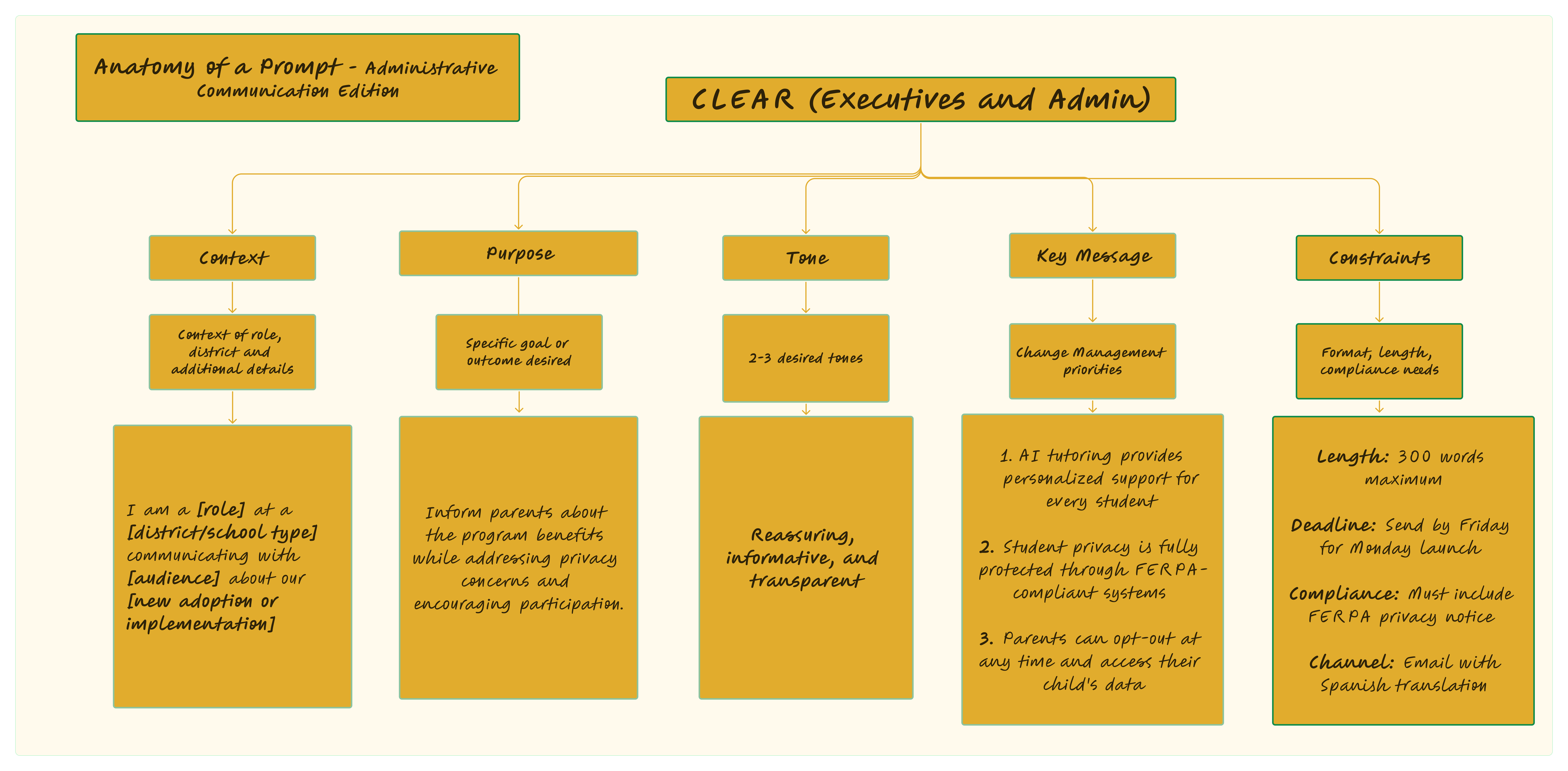
Executive Prompt Framework for Leaders
Understanding Different Prompt Types
LLM (Large Language Model) Prompts
LLM prompts are text-based instructions that guide AI language models to generate specific types of content. They're ideal for lesson planning, content creation, assessment design, and administrative tasks.
Video Generation Prompts
Video prompts describe visual scenes, actions, and narratives for AI video creation tools. They're perfect for creating educational content, training materials, and engaging presentations.
Image Generation Prompts
Image prompts describe visual elements, styles, and compositions for AI image creation. They're excellent for creating visual aids, diagrams, and engaging classroom materials.
Instruction Prompt Anatomy
Instruction prompts are designed for educators to create lesson plans, assessments, and classroom activities. They follow a specific structure that ensures clarity and effectiveness.
Key Components:
- Role Definition: Specify the AI's role (e.g., "You are an experienced K-12 educator")
- Context Setting: Provide background information and learning objectives
- Specific Task: Clearly define what you want the AI to create or analyze
- Format Requirements: Specify output format, length, and structure
- Quality Criteria: Define success metrics and evaluation standards
Example Instruction Prompt:
Role: You are an experienced 8th-grade science teacher with expertise in inquiry-based learning.
Context: I need to create a 45-minute lesson on climate change for diverse learners including students with IEPs.
Task: Design a lesson plan that includes a hook, guided inquiry activity, and formative assessment.
Format: Provide the lesson plan in a structured format with clear time allocations and learning objectives.
Quality: Ensure the lesson is engaging, accessible, and aligned with NGSS standards.
Executive Prompt Anatomy
Executive prompts are designed for educational leaders to address strategic challenges, policy development, and organizational transformation. They require a different approach focused on high-level thinking and strategic outcomes.
Key Components:
- Strategic Context: Define the broader organizational and educational landscape
- Challenge Statement: Clearly articulate the problem or opportunity
- Stakeholder Analysis: Identify key players and their interests
- Success Criteria: Define measurable outcomes and impact metrics
- Implementation Framework: Request actionable steps and timeline
Example Executive Prompt:
Context: Our district serves 15,000 students across 25 schools with varying technology infrastructure and digital literacy levels.
Challenge: We need to develop a comprehensive AI integration strategy that addresses equity concerns and prepares students for future workforce demands.
Stakeholders: Include perspectives from teachers, administrators, parents, students, and community partners.
Success: Provide a 3-year roadmap with specific milestones, resource requirements, and success metrics.
Implementation: Include risk mitigation strategies and change management approaches.
General Prompting Best Practices
1. Be Specific and Clear
Vague prompts lead to generic responses. Use precise language, specific examples, and clear instructions to get the exact output you need.
2. Provide Context and Examples
Give the AI enough background information and provide examples of what you're looking for. This helps the AI understand your expectations and context.
3. Set Constraints and Parameters
Define length limits, tone requirements, target audience, and specific formats. Constraints help focus the AI's output and ensure relevance.
4. Use Iterative Refinement
Start with a basic prompt and refine it based on the AI's response. Ask follow-up questions and provide feedback to improve results.
5. Test and Validate
Always review AI-generated content for accuracy, appropriateness, and alignment with your educational goals. Use multiple prompts to compare outputs.
6. Maintain Ethical Standards
Ensure your prompts promote inclusive, bias-free content and align with your institution's values and policies.
Prompt Engineering for Different AI Tools
ChatGPT and Similar LLMs
- Use clear, conversational language
- Break complex requests into smaller parts
- Ask for step-by-step explanations
- Request specific formats (bullet points, tables, etc.)
AI Image Generators (DALL-E, Midjourney)
- Describe visual elements in detail
- Specify artistic style and mood
- Include technical specifications (aspect ratio, quality)
- Use descriptive adjectives and visual language
AI Video Generators
- Describe scenes sequentially
- Specify camera angles and movements
- Include timing and pacing details
- Describe visual style and atmosphere
Ready-to-Use Prompt Templates
Content Creation Template
Role: [Define AI's expertise]
Task: Create [specific content type] about [topic]
Audience: [Target audience description]
Format: [Output format requirements]
Style: [Tone and style preferences]
Problem-Solving Template
Problem: [Clear problem statement]
Context: [Background information]
Constraints: [Limitations and requirements]
Desired Outcome: [What success looks like]
Approach: [Preferred methodology or framework]
Analysis Template
Subject: [What to analyze]
Perspective: [Analysis viewpoint or framework]
Criteria: [Evaluation standards]
Output: [Analysis format and structure]
Insights: [What insights you're seeking]
Ready to Master Prompt Engineering?
Transform your AI interactions and create more effective educational content with our comprehensive prompt engineering approach.